
Make Fake Windows
Patterns in (one writer's) neurodivergent writing

It sounds so grand, but I’ve put that title in its correct place, not the title but the subtitle, because my thoughts have not fully formed here.
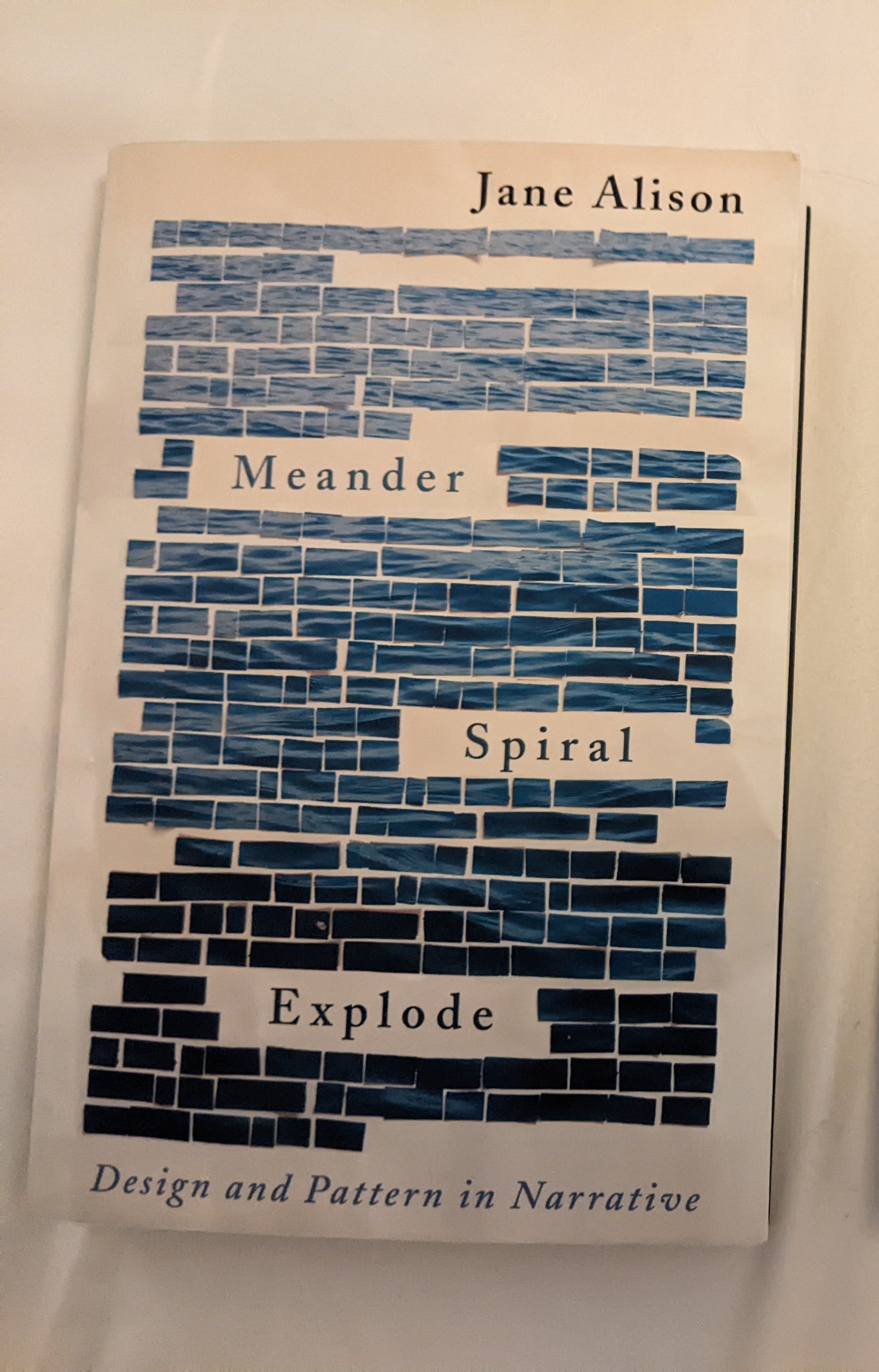
(a photograph of Meader, Spiral, Explode: Design and Pattern in Narrative by Jane Alison)
I’ve been reading the above book, devouring it. It talks clearly and calmly about patterns of structure that differ to the usual dramatic climactic arc formula that has ruled the rulebooks about writing forever and ever. Instead spiral forms. Fractals. Explosive moments that form the heart of some books. Cellular arrangments deliberately lacking in release.
The book invited further forms to be considered, graciously so. It is a friendly text, perfect to hand to students looking to have permission for other pathways through their own works.
But it has made me fretful
[because I am quite often fretful]
I thought of the writing style of my books to date. And saw a pattern in them. Not throughout all, but definitely present. And one that I think might not be easy for those whose minds do not work the same way as mine to enjoy.
I have some obsessive qualities, internally. I think, overthink. That is not unusual. But the quantity of it, perhaps, is (so hard to judge, of course).
[After most gatherings, my brain recounts over and over what I said that was less than stellar, long into the night, and the next day. The emotional hungover, far worse than one from drinking, which I don’t do too much of these days.]
[So it is: I think on the same track, worn grooves]
[over and over: this is wrong. Fix. This is a thought: go over it until it sharpens and cuts but is, in some way, worth remembering]
[I have a warring battle with my brain sometimes for what it wishes to show me]
And to reflect this reality, I write characters into recursive loops. I write titles for short fiction which feel like traps, and I follow the lines round and round, scouring. See also the parentheses, deliberately walled, which I use often. It is an organising principal, a signal of footnote and linkchain too. I did this quite consciously with Bitterhall - the first narrator speaks of his intrusive thoughts, the narrative connects and overlaps (lap is too gentle)(overgrinds) across the same territory as it is experienced by two others, whose inner minds cannot reach one another - until (spoilers) the end. Unity and accord as narrative release. That was the aim.
It has been viewed, I think, as stagnating. But that feature is supposed to be part of the novel, reflecting trapped minds and stuck relationships. Life loops. That certain things cannot be got away from.
1. That copies (one of the other themes of the book - highly advanced 3D printed copies of unique objects, the book as a copied thing, and so on) will reproduce themselves, with errors, additions, human or accidental.
2. That reality, for those with mental health issues, means something different for the reality of “realism”. The sentences too beautiful and slow. But a mind stuck in whirring action, over and over, will perfect. As a reasonable response to the spatial loop, make a finer space to be trapped within. Making fake windows a little prettier if you are looking out at scenery which blurs and stays at the same point for a while.
[it may be apparent that where intention and impulse are is occasionally unclear]
[As I said, I am still processing] [it takes time, oh so much]
Last night I wrote this page over and over, and now it is quite different, but the grove remains.
Some readers connect to the grinding and the whirring and those specifically crafted sentences, and some do not. That, I always anticipated when I decided to write. I knew that I was experimenting, that I was deliberately choosing to write, though I find it difficult (I am dyslexic too). Though I fail to make the best of the work. Ease is unfamiliar, anyway. Why not struggle, if you are struggling anyway, in an artistic way? You can make a bit of grandeur out of that.
I am grateful and tired after reading Meander, Spiral, Explode. And encourage anyone who has similar - or wildly different - mental landscapes to follow their pattern. But it’s good I think to know that it will not always be easy to publish, to find the right editor, to find your own peace with the method. To be understood as coming to the pattern from oblique or unsettling angles. Or to deal with any of the above, on top of having a self, at parties.
Oh, I love this book! It's sitting in front of me. I read it in one afternoon earlier this year - too fast in fact. I need to go back through it.